
At the heart of any relational database management system (RDBMS) - whether PostgreSQL, MySQL, or SQLite - lies the concept of relationships. Unlike unstructured NoSQL stores that duplicate nested JSON documents, relational engines organize data into specialized tables and bind them together using Foreign Keys (FK).
For new developers, junior analysts, or anyone building complex database architectures, grasping how foreign keys maintain referential integrity across multiple entities can feel abstract when looking purely at text-based DDL scripts.
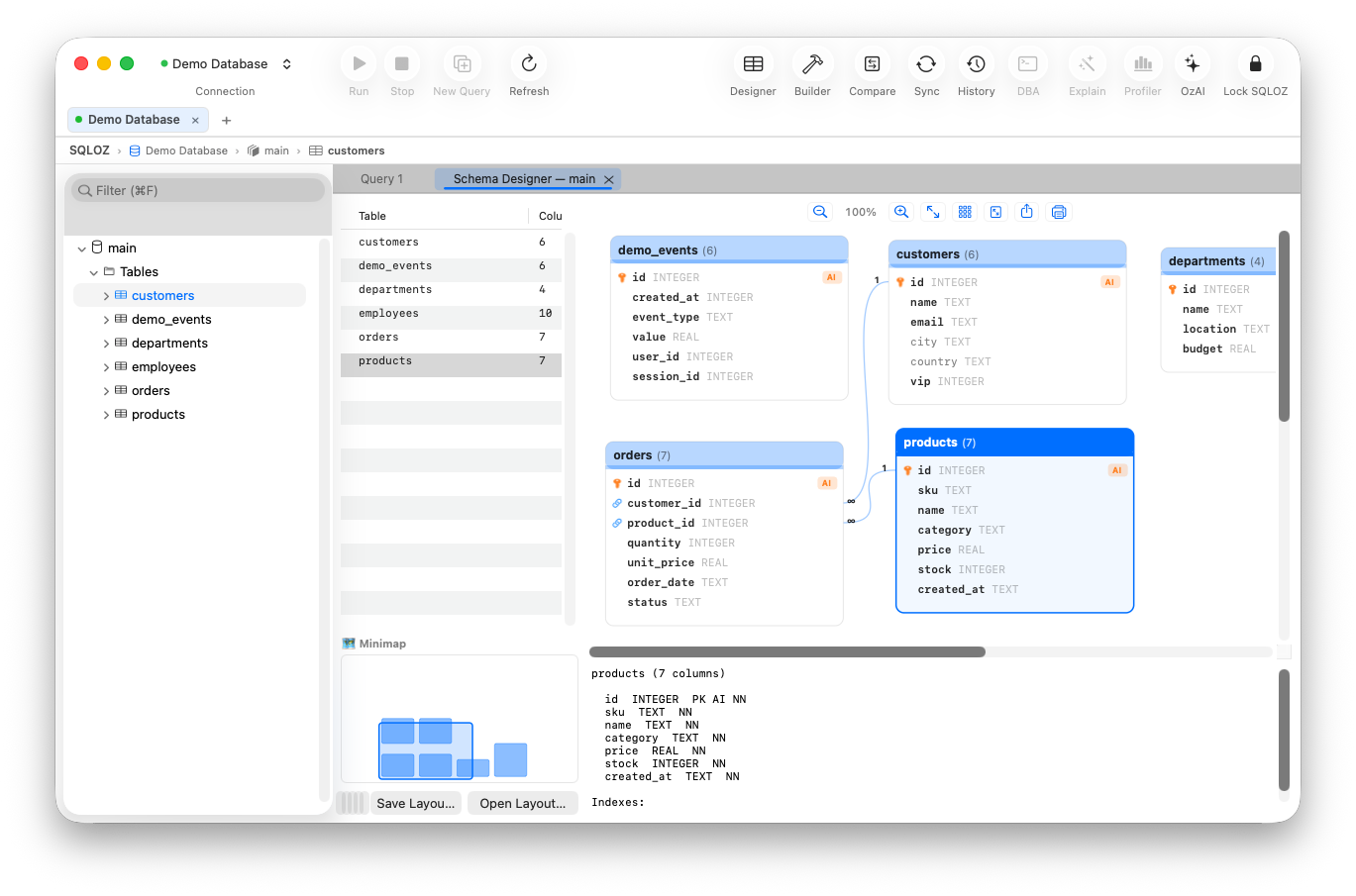
In this visual guide, we break down the three fundamental relational patterns (One-to-One, One-to-Many, and Many-to-Many) and show how modern Mac developers use interactive visual schema designers to model, inspect, and maintain relational integrity.
1. What Exactly Is a Foreign Key?
A Foreign Key is a column (or group of columns) in one table that provides a link to the Primary Key (PK) of another table.
Think of it as an enforced contract:
- The Parent Table: Holds the primary authoritative record (e.g.,
customers). - The Child Table: Holds dependent records that point back to the parent (e.g.,
orders). - Referential Integrity: The database engine strictly forbids inserting an order for a
customer_idthat does not exist in thecustomerstable.
2. The 3 Core Types of Table Relationships
Type 1: One-to-One (1:1)
In a One-to-One relationship, each row in Table A can correspond to at most one row in Table B, and vice versa.
- Real-World Example:
usersanduser_profiles(oruser_settings). - Why split them? Performance and security. You might store basic auth credentials in
usersand isolate large profile biographies or sensitive biometric preferences inuser_profiles. - SQL Implementation:
CREATE TABLE user_profiles (
    user_id BIGINT PRIMARY KEY,
    bio TEXT,
    timezone VARCHAR(50),
    CONSTRAINT fk_profile_user FOREIGN KEY (user_id) REFERENCES users(id) ON DELETE CASCADE
);
Type 2: One-to-Many (1:N) - The Workhorse of RDBMS
This is by far the most common relationship in relational databases. A single parent record can have zero, one, or thousands of associated child records, but each child record belongs to exactly one parent.
- Real-World Example: One
Customerhas manyOrders. OneAuthorwrites manyArticles. - SQL Implementation:
CREATE TABLE orders (
    id BIGINT GENERATED BY DEFAULT AS IDENTITY PRIMARY KEY,
    customer_id BIGINT NOT NULL,
    total_amount NUMERIC(10, 2) NOT NULL,
    created_at TIMESTAMPTZ DEFAULT CURRENT_TIMESTAMP,
    CONSTRAINT fk_orders_customer FOREIGN KEY (customer_id) REFERENCES customers(id)
);
Type 3: Many-to-Many (N:M) & The Junction Table
In a Many-to-Many relationship, multiple rows in Table A can be associated with multiple rows in Table B.
Relational engines cannot represent this directly with a single foreign key. Instead, you introduce an intermediary table known as a Junction Table (or Pivot / Join table).
- Real-World Example:
studentsandcourses(a student enrolls in multiple courses, and a course contains multiple students). Orproductsandtags. - Visual Architecture:
[ Products ] (1) ◄──── (N) [ Product_Tags (Junction) ] (N) ────► (1) [ Tags ]- SQL Implementation:
CREATE TABLE product_tags (
    product_id BIGINT NOT NULL,
    tag_id BIGINT NOT NULL,
    PRIMARY KEY (product_id, tag_id),
    CONSTRAINT fk_pt_product FOREIGN KEY (product_id) REFERENCES products(id) ON DELETE CASCADE,
    CONSTRAINT fk_pt_tag FOREIGN KEY (tag_id) REFERENCES tags(id) ON DELETE CASCADE
);
3. The Power of a Visual Database Schema Designer on Mac
Reading hundreds of lines of CREATE TABLE and ALTER TABLE ... ADD CONSTRAINT statements in a terminal makes it nearly impossible to grasp the full topological graph of an enterprise database.
Using a native macOS tool like SQLOZ Schema Designer transforms this workflow:
- Auto-Generated Entity-Relationship Diagrams (ERD): SQLOZ automatically inspects the database catalog (
information_schema.table_constraints), parses all foreign key dependencies, and generates a clean visual map on an infinite, hardware-accelerated canvas. - Visual Foreign Key Creation: To connect two tables, simply drag a relationship connector line from a column in one table card to another. SQLOZ will open a lightweight HUD where you can configure cascade rules:
ON DELETE CASCADE(automatically remove children when parent is deleted)ON DELETE SET NULL(retain children but disconnect reference)ON DELETE RESTRICT(prevent parent deletion if children exist)
- Export to Vector Graphics: Export your complete relational schema as high-resolution SVG or PNG images to share with product managers, security auditors, or frontend teams during architecture reviews.
Summary
Mastering foreign keys and table relationships is the bedrock of robust software engineering. When you can visualize your data architecture, spotting circular dependencies, orphan records, and missing indices becomes second nature.
Ready to explore your database visually?
Download SQLOZ for macOS and experience the ultimate native schema visualizer on Apple Silicon.