
TablePlus is undeniably one of the most widely used native database clients on macOS. When it launched, it provided a much-needed breath of fresh air against the clunky Java and Electron tools that dominated developer desktops.
However, many engineers eventually hit roadblocks that prompt them to search for TablePlus alternatives:
- The 2-Tab & 2-Filter Free Limit: Constantly closing and reopening tabs to navigate staging and local environments is a persistent annoyance.
- Missing Visual Query Tooling: TablePlus does not have a visual query builder; you must write all multi-table joins, subqueries, and grouping logic manually.
- No Cross-Dialect Migration: Moving data from SQLite to PostgreSQL or MySQL requires clumsy manual export/import gymnastics.
- License Cost: At $89 per seat (with paid renewal for future updates), teams and indie developers often seek more capable options.
Here are the top 5 native Mac database clients to consider as alternatives to TablePlus in 2026.
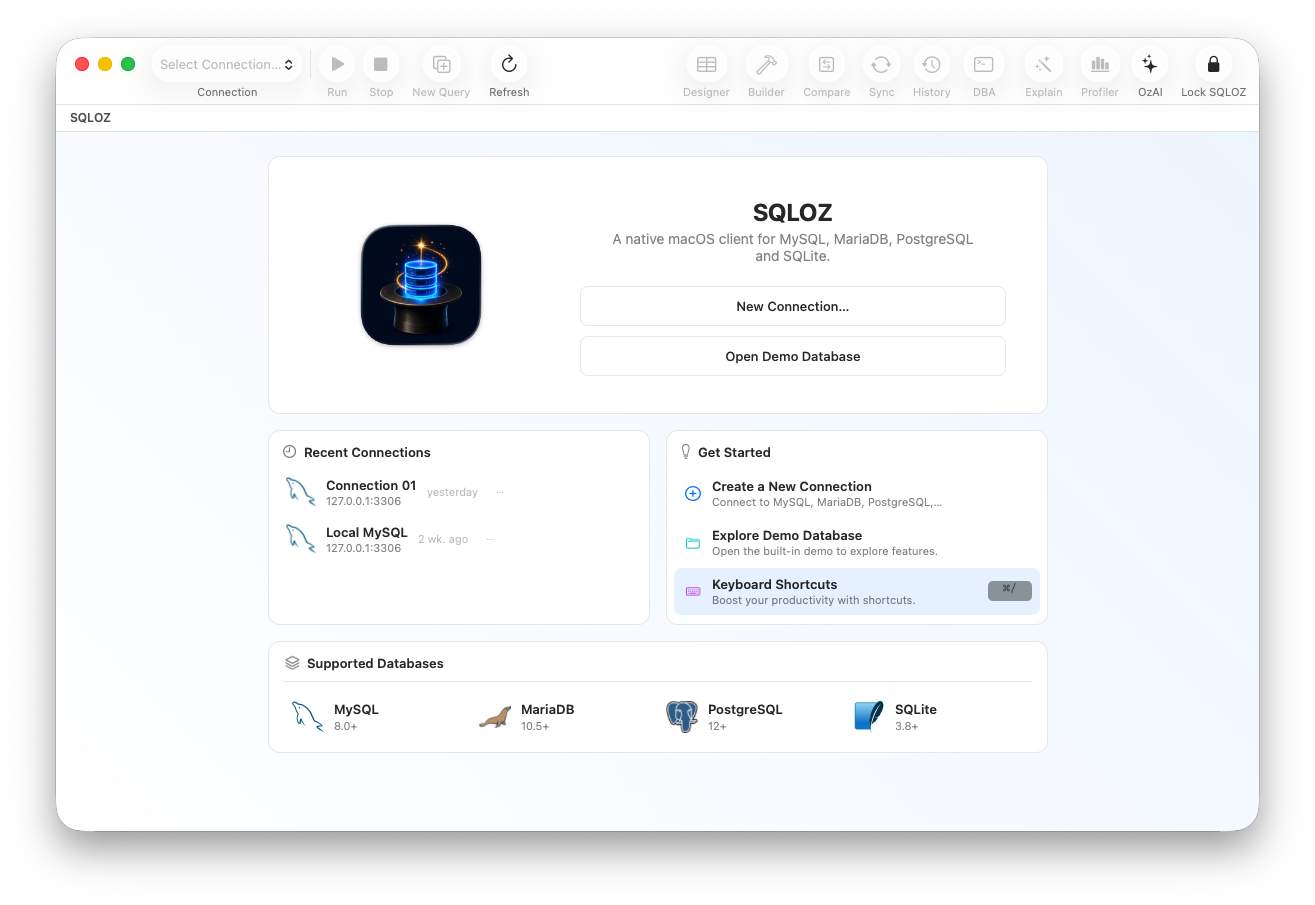
1. SQLOZ: The Ultimate Unconstrained Native Alternative
If you love TablePlus’s native macOS responsiveness but need unconstrained multi-tab workflows, an interactive visual query builder, and deep DBA diagnostics, SQLOZ is the premier choice.
- Architecture: 100% Native macOS (Swift, AppKit, Metal).
- Supported Engines: MySQL, MariaDB, PostgreSQL, SQLite.
- Why it beats TablePlus:
- Interactive Visual Query Builder: Drag and drop tables, connect foreign keys visually, and preview live SARGable SQL.
- Cross-Dialect Migration Engine: One-click migration between MySQL, Postgres, and SQLite over encrypted SSH Tunnels.
- Production Safety Gate: Automated static analysis halts dangerous
UPDATEorDELETEqueries missingWHEREclauses. - Enterprise Credential Security: Direct integration with the hardware-backed macOS Keychain.
2. Sequel Ace (Best for MySQL-Only Stacks)
For developers working exclusively with MySQL or MariaDB, Sequel Ace is a completely free, open-source native alternative.
- Pros: 100% free; unlimited tabs and filters; familiar Sequel Pro layout.
- Cons: No PostgreSQL or SQLite support; occasional stability issues under heavy result sets.
- Verdict: Great for simple MySQL environments.
3. DataGrip (JetBrains)
JetBrains DataGrip is a heavyweight IDE designed for professional database developers and data architects.
- Pros: Deep code completion; extensive refactoring; integrated VCS.
- Cons: Built on the JetBrains Java runtime; high RAM consumption (1.2GB+); expensive recurring subscription.
- Verdict: Best for engineers who already live inside IntelliJ or WebStorm.
4. Beekeeper Studio
Beekeeper Studio is a modern, open-source multi-engine database GUI.
- Pros: Supports PostgreSQL, MySQL, SQLite, and SQL Server; slick interface.
- Cons: Built on Electron; higher memory usage and slower grid rendering than pure native Swift clients.
- Verdict: Solid cross-platform pick, but not a true native macOS app.
5. Postico 2 (Postgres-Only)
Postico 2 is a beloved native Mac client dedicated exclusively to PostgreSQL.
- Pros: Pure native macOS feel; excellent view of PostgreSQL types, JSONB, and schemas.
- Cons: PostgreSQL only (zero support for MySQL or SQLite); commercial pricing.
- Verdict: Beautiful for PostgreSQL purists, but inflexible for multi-database stacks.
Feature Comparison Matrix
| Feature | TablePlus | SQLOZ (Native Mac) | Sequel Ace | Postico 2 |
|---|---|---|---|---|
| Native macOS Architecture | ✅ Yes | ✅ Yes (Swift/Metal) | ✅ Yes | ✅ Yes |
| Engines Supported | Multi-engine | Multi-engine (MySQL, PG, SQLite) | MySQL Only | Postgres Only |
| Tab Restrictions | 2 Tabs (Free) | Unlimited Tabs | Unlimited Tabs | Tab limits |
| Visual Query Builder | ❌ None | ✅ 120 FPS Drag-and-Drop | ❌ None | ❌ None |
| Cross-Dialect Migration | ❌ None | ✅ One-Click Binary Stream | ❌ None | ❌ None |
| Average Idle RAM | ~90 MB | 45 MB – 75 MB | ~110 MB | ~80 MB |
Summary
You don’t have to tolerate tab limits or lack of visual modeling just to get a native database client on your Mac.
Upgrade your daily database workflow with SQLOZ.
Download SQLOZ for macOS and experience the power of unconstrained native engineering.