
The ENUM data type in MySQL is a popular choice for columns with a constrained set of discrete values, such as order statuses ('pending', 'processing', 'shipped', 'delivered') or user role permissions ('admin', 'editor', 'viewer').
Under the hood, MySQL stores ENUM values as compact 1-byte or 2-byte integers while presenting readable string literals to client applications. This compact storage improves index density and ensures strict data validation at the database layer.
However, as business requirements evolve, developers frequently need to append new status choices, reorder values, or deprecate legacy states. If executed incorrectly, altering an ENUM definition on a large production table can trigger a costly table copy and exclusive metadata locks.
In this guide, we explore how MySQL handles ENUM columns internally, provide safe SQL alter patterns, and demonstrate how to manage ENUM values visually using native macOS tooling.
1. How MySQL Manages ENUMs Internally
When you define an ENUM:
CREATE TABLE orders (
    id INT PRIMARY KEY AUTO_INCREMENT,
    status ENUM('pending', 'paid', 'shipped', 'cancelled') NOT NULL DEFAULT 'pending'
);
MySQL does not store the full string literals inside each record page. Instead, it maps each string to an integer index:
'pending'$\rightarrow$1'paid'$\rightarrow$2'shipped'$\rightarrow$3'cancelled'$\rightarrow$4
Because of this integer mapping, sorting an ENUM column (ORDER BY status) orders by the underlying integer index rather than alphabetical string sequence!
2. The Locking Trap: Adding Values to an ENUM
A common operational task is adding a new state (e.g., 'refunded') to an existing column:
-- Is this ALTER TABLE fast or slow?
ALTER TABLE orders
MODIFY COLUMN status ENUM('pending', 'paid', 'shipped', 'cancelled', 'refunded')
NOT NULL DEFAULT 'pending';
The Golden Rule of MySQL Online ENUM Modifications:
- Appending to the End: In MySQL 5.7+ and 8.0+, appending a new value to the very end of the
ENUMlist is an instant metadata-only operation (ALGORITHM=INPLACEorALGORITHM=INSTANT). It completes in milliseconds without rebuilding the table! - Inserting in the Middle: If you attempt to insert
'refunded'in the middle of the list (e.g., between'paid'and'shipped'), MySQL must re-index the internal integer representations for all existing rows. This triggers a full table rebuild (ALGORITHM=COPY), which can lock a high-volume production table for minutes or hours.
[!TIP] Always append new
ENUMvalues to the end of the existing definition list to take advantage of instant metadata operations in MySQL 8.0.
3. Querying Existing ENUM Options via SQL
To inspect all valid options currently permitted for an ENUM column, query the information schema:
SELECT
    COLUMN_TYPE
FROM information_schema.COLUMNS
WHERE TABLE_SCHEMA = DATABASE()
  AND TABLE_NAME = 'orders'
  AND COLUMN_NAME = 'status';
-- Returns: enum('pending','paid','shipped','cancelled')
Parsing this returned string in custom application scripts or bash routines requires awkward regex matching.
4. Visual ENUM Management with SQLOZ (macOS Native)
Managing ENUM lists should not require drafting complex ALTER TABLE ... MODIFY COLUMN scripts or worrying about internal integer ordering.
SQLOZ provides an interactive, native ENUM editor built directly into its macOS schema inspection tools.
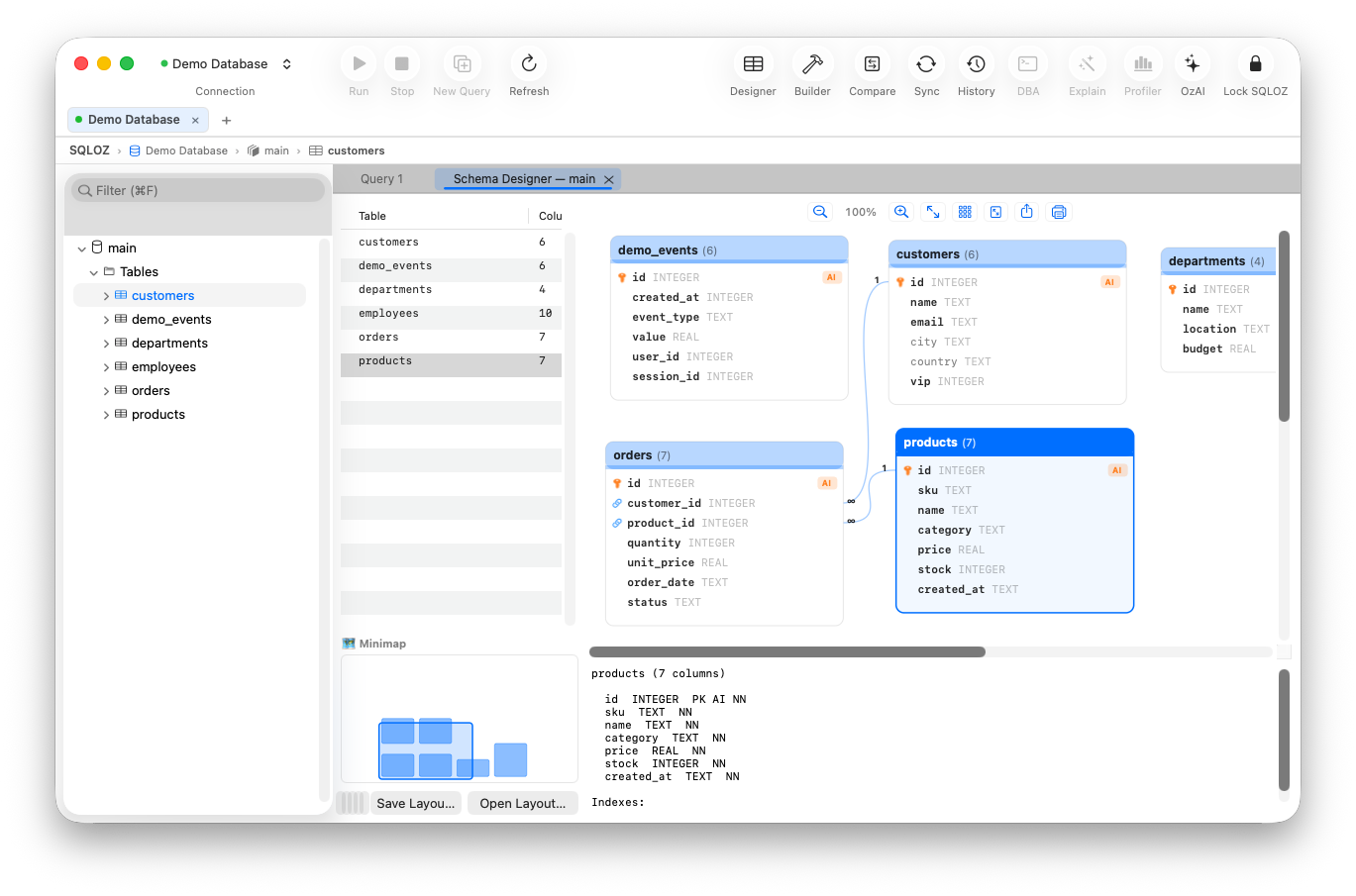
Features of SQLOZ ENUM Management:
- Interactive Token Management: Inside the Table Structure editor, clicking an
ENUMcolumn reveals an intuitive token sheet. Add new options, reorder values, or remove unused states with simple drag-and-drop simplicity. - Instant Algorithm Verification: SQLOZ analyzes your changes before submitting. If your edit appends values to the end, it verifies that MySQL can execute the modification using
ALGORITHM=INSTANT. If your change requires a table rebuild, SQLOZ displays a warning indicator before you apply the change. - Dropdown Selection in Table Data Grid: When editing rows inside the SQLOZ Table Data Grid, columns typed as
ENUMrender an elegant native macOS pop-up picker, preventing typographical errors and data validation failures.
Summary
ENUM columns provide excellent storage efficiency and strict data integrity for discrete status fields. By appending new values to the end of lists to leverage instant metadata updates and using native visual tools like SQLOZ, developers can evolve their schema definitions safely without downtime.
To learn more about safe schema modifications and column alterations, check out our guide on How to Change Column Data Types in MySQL Without Dropping Tables and discover our tutorial on Zero-Downtime Schema Migrations.