
Before writing a single backend API endpoint or database migration script, mapping out your Entity-Relationship Diagram (ERD) is one of the most critical phases of software engineering.
Visualizing your schema lets you:
- Spot circular foreign key dependencies before they cause runtime deadlocks,
- Identify missing indexes on frequently joined foreign key columns,
- Communicate domain architecture clearly to product managers, frontend engineers, and security auditors.
However, many standalone diagramming tools (like Lucidchart or draw.io) are disconnected from your actual database: every schema change requires tedious manual redrawing.
In this guide, we evaluate the best visual SQL schema designers for macOS in 2026 that bridge the gap between live database introspection and visual diagramming.
What Makes a Great Mac Schema Designer?
- Live Database Introspection: Automatically inspect system catalogs (
information_schema) and generate clean visual cards without manual drawing. - Interactive Relationship Modeling: Connect columns to establish Foreign Key constraints with cascade rule options (
ON DELETE CASCADE,RESTRICT). - High-Performance Canvas: Fluid 120 FPS panning and zooming on Apple Silicon, even across schemas with 100+ interconnected tables.
- Vector Export: Export diagrams as crisp, scalable SVG or high-resolution PNG images for team wikis and architectural documentation.
1. SQLOZ Schema Designer (Ranked #1 for macOS)
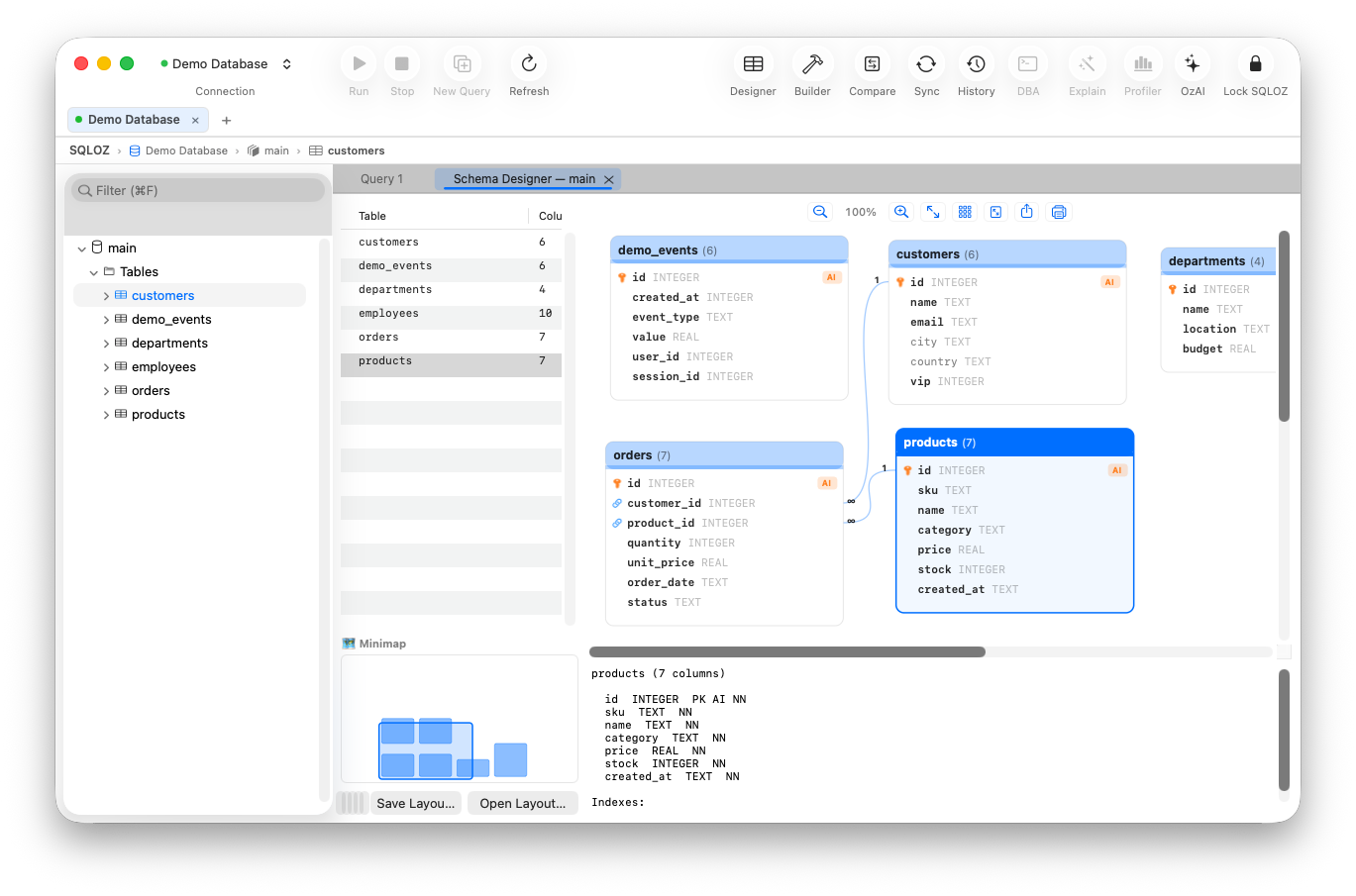
SQLOZ provides a state-of-the-art Schema Designer built in Swift and Metal specifically for Mac developers.
- Auto-Generated ERDs: Double-click any database connection, and SQLOZ automatically maps foreign keys, indexes, and primary key badges on an infinite canvas.
- Visual Migration Compilation: Add tables, modify column types, and establish foreign keys visually. SQLOZ generates the exact, safe
ALTER TABLEDDL migration script to apply changes to your server. - Vector Graphic Export: Export complete schema topologies as high-resolution SVG or PNG with one click.
- Apple Silicon Metal Acceleration: Smooth, anti-aliased Bézier connector curves that render flawlessly at 120 FPS on ProMotion displays.
2. DBeaver ER Diagrams
DBeaver generates automatic entity relationship diagrams from JDBC metadata.
- Pros: Free in the Community edition; supports any database.
- Cons: Java/Eclipse canvas feels slow and difficult to organize; auto-layout algorithms often produce tangled, overlapping lines; high memory usage.
- Verdict: Capable for quick reference, but clunky for professional architecture design.
3. Navicat Data Modeler
A dedicated standalone commercial tool from the makers of Navicat.
- Pros: Comprehensive conceptual, logical, and physical modeling tools.
- Cons: Expensive separate license ($400+); non-native interface styling.
- Verdict: Solid for dedicated corporate enterprise data architects.
4. Standalone Web Tools (dbdiagram.io)
A popular web-based DSL tool for quick DBML schema sketches.
- Pros: Clean web UI; easy URL sharing.
- Cons: Disconnected from your live database. You have to manually update DBML files whenever a migration runs.
- Verdict: Great for brainstorming, but not for live database management.
Schema Designer Comparison Table
| Tool | Architecture | Live DB Introspection | Visual FK Modeling | Export to SVG/PNG | Price |
|---|---|---|---|---|---|
| SQLOZ | Pure Swift & Metal | ✅ Instant Auto-Inspect | ✅ Drag-and-Drop | ✅ High-Res SVG/PNG | Affordable / Free Eval |
| DBeaver | Java / Eclipse | ✅ Supported | ⚠️ Clunky | ⚠️ Basic Image | Free Open Source |
| Navicat Modeler | C++ / Qt | ✅ Supported | ✅ Advanced | ✅ Supported | $400+ |
| dbdiagram.io | Web (Browser) | ❌ Manual DBML | ❌ DSL Code Only | ✅ Supported | Free / Subscription |
Summary
Designing and maintaining relational database schemas shouldn’t feel like wrestling with clunky, disconnected diagramming software.
With SQLOZ, Mac developers get an integrated, hardware-accelerated visual schema designer that connects directly to live MySQL, PostgreSQL, and SQLite databases.
Download SQLOZ for macOS and visualize your database architecture today.