
While migrating raw table structures and row data between MySQL and PostgreSQL is a well-understood process, migrating **database logic - specifically Views, Triggers, and Stored Procedures - **is often where cross-dialect migrations hit a brick wall.
Unlike standard ANSI SQL SELECT queries, procedural extensions and trigger architectures diverge sharply between MySQL and PostgreSQL:
- MySQL embeds trigger bodies directly inside the
CREATE TRIGGERstatement, whereas PostgreSQL mandates that all triggers execute an independent stored function (PL/pgSQL) returning aTRIGGERpseudotype. - MySQL views often utilize non-standard dialect functions (such as
IFNULL(),NOW(), orDATE_ADD()) that PostgreSQL does not natively provide without translation. - Variable assignment syntax differs (
SET @var = ...vsvar := ...).
In this visual guide, we dissect the core procedural differences between both database engines and demonstrate how to review, translate, and deploy MySQL views and triggers to PostgreSQL using SQLOZ on macOS.
1. Migrating Views: MySQL vs. PostgreSQL Syntax
In MySQL, views are often defined with inline function calls that lack direct equivalents in PostgreSQL.
Example: Translating a Summary View
MySQL View Definition:
CREATE VIEW user_order_summaries AS
SELECT
    u.id AS user_id,
    u.email,
    IFNULL(SUM(o.total_amount), 0.00) AS total_spent,
    DATE_FORMAT(MAX(o.created_at), '%Y-%m-%d') AS last_order_date
FROM users u
LEFT JOIN orders o ON u.id = o.customer_id
GROUP BY u.id, u.email;
The PostgreSQL Translation:
In PostgreSQL, IFNULL() must be replaced with ANSI standard COALESCE(), and DATE_FORMAT() must be replaced with TO_CHAR():
CREATE VIEW user_order_summaries AS
SELECT
    u.id AS user_id,
    u.email,
    COALESCE(SUM(o.total_amount), 0.00) AS total_spent,
    TO_CHAR(MAX(o.created_at), 'YYYY-MM-DD') AS last_order_date
FROM users u
LEFT JOIN orders o ON u.id = o.customer_id
GROUP BY u.id, u.email;
2. Migrating Triggers: The PL/pgSQL Function Requirement
The biggest architectural divergence occurs in triggers.
In MySQL: Triggers are Inline
In MySQL, you write the trigger logic directly inside the trigger declaration:
-- MySQL:
DELIMITER $$
CREATE TRIGGER before_user_update
BEFORE UPDATE ON users
FOR EACH ROW
BEGIN
    SET NEW.updated_at = NOW();
END$$
DELIMITER ;
In PostgreSQL: Two-Step Function + Trigger Architecture
PostgreSQL does not allow inline procedural logic in CREATE TRIGGER. You must first create a standalone FUNCTION using the plpgsql procedural language, and then attach the trigger to that function:
-- Step 1: Create the reusable trigger function
CREATE OR REPLACE FUNCTION update_timestamp_func()
RETURNS TRIGGER AS $$
BEGIN
    NEW.updated_at = CURRENT_TIMESTAMP;
    RETURN NEW;
END;
$$ LANGUAGE plpgsql;

-- Step 2: Attach the trigger to the table
CREATE TRIGGER before_user_update
BEFORE UPDATE ON users
FOR EACH ROW
EXECUTE FUNCTION update_timestamp_func();
3. Visual DDL Inspection and Comparison with SQLOZ
Navigating these syntax translations manually across dozens of views and triggers across multiple microservices is error-prone.
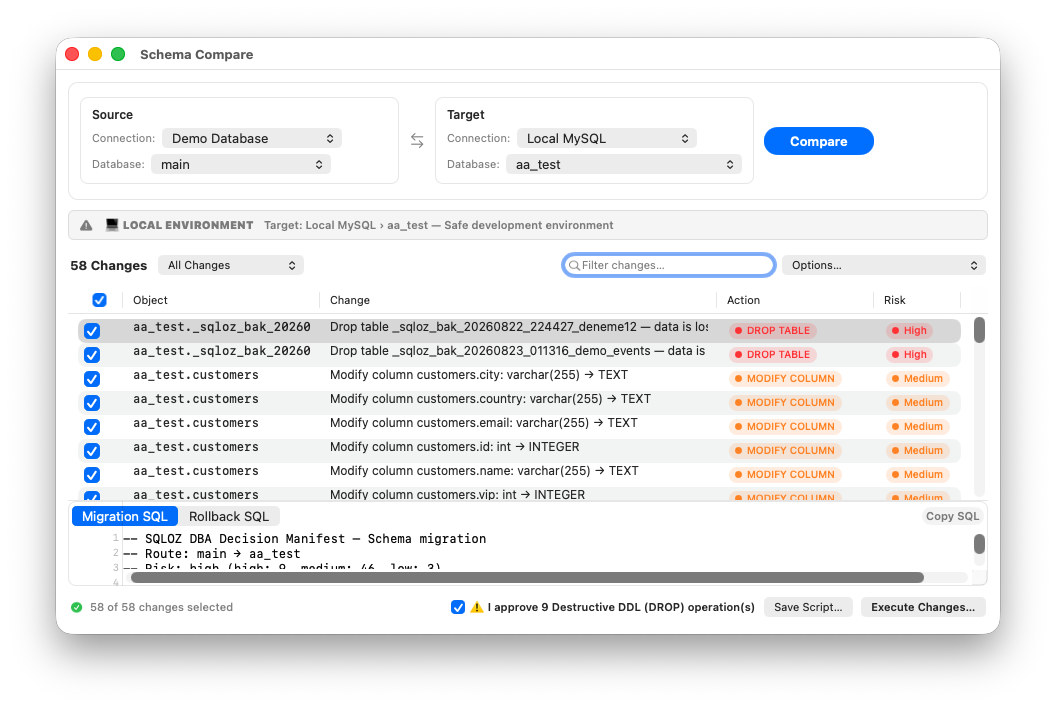
SQLOZ features an advanced Schema Compare & Diff engine built for macOS:
- Object Hierarchy Diff: Connect both MySQL and PostgreSQL in SQLOZ. The Schema Compare tool visually highlights views, triggers, and functions with colored diff badges (Identical, Modified, Missing).
- Side-by-Side Syntax Inspection: Click on any view or trigger to inspect its DDL definition side-by-side with full syntax highlighting.
- Assisted AI Dialect Translation (OzAI): Highlight a MySQL trigger body and ask the integrated OzAI SQL Assistant to translate the procedural code into standard PostgreSQL
PL/pgSQLwith safe variable bindings. - Attended Execution: Review the generated PostgreSQL DDL scripts and execute them with rollback transaction guards.
Summary
Migrating database business logic between MySQL and PostgreSQL requires understanding procedural paradigms like PL/pgSQL trigger functions and ANSI standard date operators.
With SQLOZ, Mac developers gain a visual, attended comparison suite that takes the mystery out of procedural database migrations.
Download SQLOZ for macOS and modernize your database schemas with clarity and confidence.